Evidence-first buyer's guide
Choose the software your operation can grow into.
Replace feature-list guesswork with a weighted scorecard, repeatable workflow demos, implementation gates and evidence every shortlisted self-storage platform must provide.
A supplier-neutral evaluation method published by StoRegister. Score the same scope and evidence for every vendor; then let your operating priorities determine the result.
01 · Define the job
Start with your operating model, not a vendor's feature count.
The best platform is the one that carries your most important work reliably across people, facilities, customer channels and markets. Write the target operation first; evaluate software second.
Independent facility
Prioritise fast adoption, a complete customer journey, dependable billing and clear daily exceptions.
- How quickly can a new team member complete core work?
- Which bookings still need manual intervention?
- Can the owner see cash, occupancy and action queues clearly?
Growing multi-site operator
Prioritise repeatable controls, portfolio reporting, permissions and local action without fragmented data.
- Which settings are central and which remain facility-specific?
- Can exceptions move from portfolio view to accountable action?
- How are rates, roles and integrations governed as sites grow?
Multi-market portfolio
Prioritise genuine localization, financial traceability, provider compatibility and data-location choices.
- Are language, tax, currency and documents operationally complete?
- Which providers are proven in each country?
- Where is data hosted and how is access controlled?
Write acceptance statements. Replace “supports online move-in” with “a new tenant can select an eligible unit, verify the required information, sign the correct agreement, make the required payment and receive the next instruction without staff re-keying data.”
Record the boundaries. Market, provider, plan, application, device, permission, configuration and implementation scope can all change whether a capability is available.
02 · Weight the decision
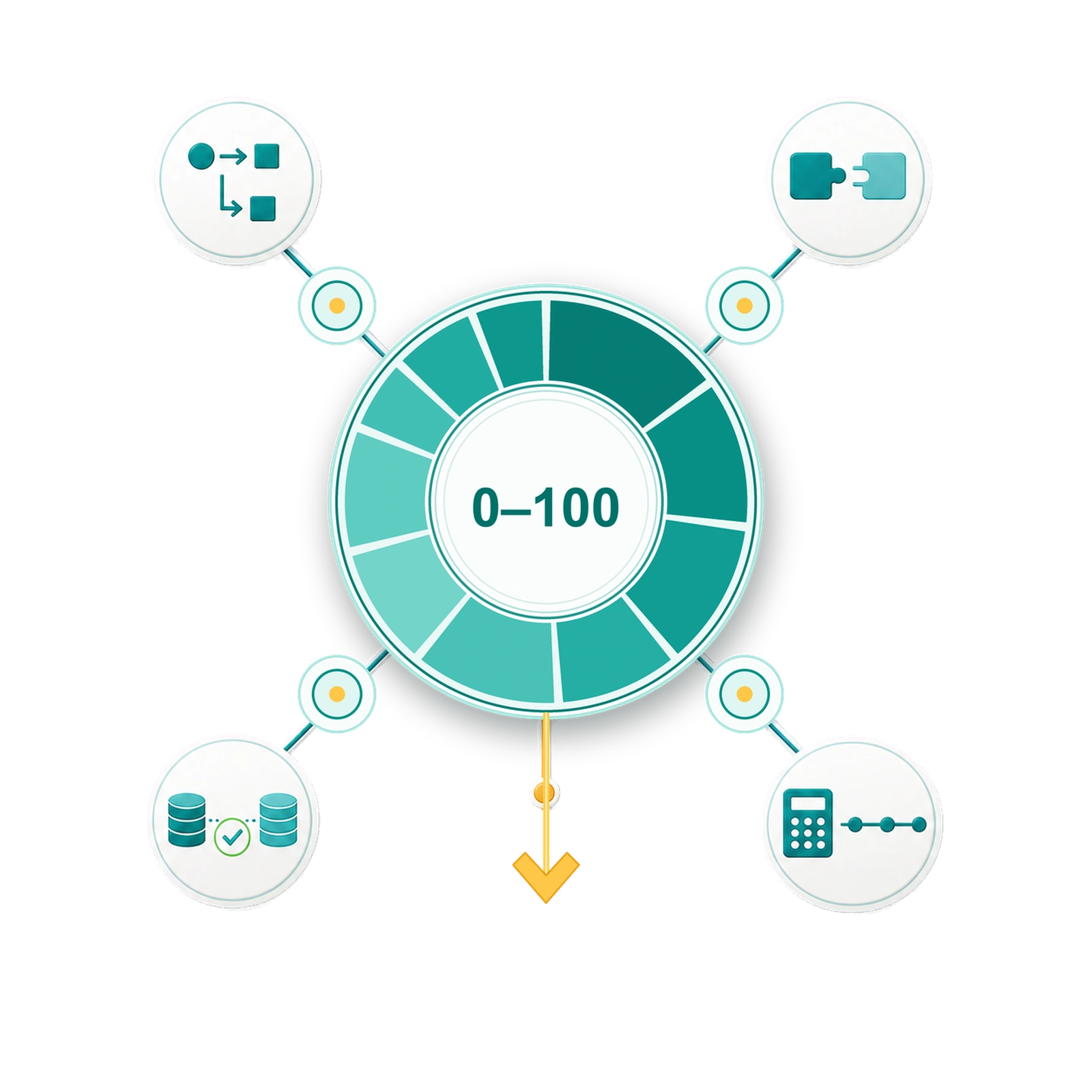
Use one 100-point scorecard for every supplier.
Adjust the weights before demonstrations begin. Score capability and evidence separately so a confident presentation cannot hide an unproven dependency.
Suggested starting weights. Rebalance them for your strategy, but keep the final total at 100.
Score 0–5 × weight| Decision area | Why it matters | Evidence to request | Suggested weight |
|---|---|---|---|
| Core operations | Daily reservations, contracts, move-ins, transfers, move-outs and unit controls must stay coherent. | Complete a live lifecycle with your roles, edge cases, permissions and audit history. | 15%Business critical |
| Booking & tenant experience | Conversion and service quality depend on a clear journey across discovery, documents and payment. | Run mobile and desktop booking, then show returning-tenant self-service and staff visibility. | 12%Revenue path |
| Billing & revenue controls | Rates, tax, invoices, receipts, refunds and collections need control without breaking traceability. | Demonstrate a price change, failed payment, partial adjustment, refund and reconciliation trail. | 12%Cash control |
| Portfolio reporting | Leaders need consistent definitions and an efficient route from exception to action. | Reconcile a dashboard value to records, filter facilities and export the exact data required. | 10%Decision quality |
| Integrations, API & access | Operational continuity depends on exact provider support, data direction and failure ownership. | Review documentation, sandbox, reference flow, monitoring, retries, limits, costs and named owners. | 12%Ecosystem risk |
| Localization & compliance | Translated screens alone do not cover local tax, currency, agreements, invoices and processes. | Test an end-to-end country journey with correct formats, documents, providers and responsibilities. | 10%Market fit |
| Security, hosting & data | Identity, permissions, resilience, ownership, location and exit terms shape long-term risk. | Request architecture, controls, recovery targets, subprocessors, data export and incident process. | 10%Risk control |
| Mobile & frontline work | Role-appropriate mobile flows prevent off-site work from becoming a disconnected side process. | Run the priority operator and tenant tasks on actual supported devices and permissions. | 6%Field adoption |
| Migration & implementation | A good product can still fail when mapping, configuration, testing and cutover lack clear gates. | Review the plan, sample migration, reconciliation, dependencies, acceptance criteria and rollback. | 7%Delivery risk |
| Support & total cost | The commercial result includes add-ons, third parties, change effort and the service you receive. | Compare a complete three-year scope, service hours, escalation path, price changes and exclusions. | 6%Long-term value |
Scoring method: rate each area from 0 (not available) to 5 (proven fit), multiply by its weight, then divide by 5. Cap “stated but not demonstrated” at 2 and record every assumption beside the score.
03 · See the work
Replace the feature tour with three scripted demonstrations.
Give every supplier the same sample business rules and expected outcome. Let them explain limitations, but do not let a polished dashboard replace the workflow you actually need.
Enquiry to compliant move-in
Test whether customer, unit, rate, identity, agreement, payment and access information remain connected.
- Capture an enquiry on the customer-facing channel.
- Recommend and reserve an eligible unit and rate.
- Complete required details, agreement and payment.
- Confirm staff visibility, customer record and next action.
Billing exception to resolution
Test the controls behind routine cash work, not only a successful card payment.
- Fail or reverse a scheduled payment.
- Show reminders, access implications and staff queue.
- Apply the permitted adjustment or resolution.
- Reconcile invoice, receipt, balance and audit history.
Portfolio signal to local action
Test whether multi-site visibility produces an accountable operational response.
- Identify an occupancy, aging or revenue exception.
- Move from portfolio result to source records.
- Assign or complete the appropriate local action.
- Confirm permissions, history and updated reporting.
04 · Verify dependencies
Turn broad promises into named evidence.
“Cloud,” “open,” “integrated,” “secure” and “multilingual” are starting points, not acceptance criteria. Resolve the details that can interrupt operations or expand cost later.
Data ownership and exit
Confirm what you can retrieve, how quickly, in which formats and at what cost during normal use and at contract end.
Evidence checklist- Export scope, identifiers, files and history
- Retention, deletion and backup treatment
- Exit assistance, timing and commercial terms
Security and resilience
Evaluate controls in relation to your data, users, markets and continuity requirements rather than relying on badges alone.
Evidence checklist- Authentication, roles, logging and review process
- Hosting location, recovery targets and testing
- Subprocessors, incidents and responsibility split
Integration reality
Verify an exact provider and use case. A marketplace logo does not explain data direction, coverage, monitoring or support.
Evidence checklist- Provider, product version, country and reference flow
- API, webhook, batch or manual boundary
- Errors, retries, limits, sandbox, cost and owner
Localization and compliance
Test the operating journey, not only translated navigation. Local financial and legal responsibilities remain shared work.
Evidence checklist- Language, currency, tax, dates and time zones
- Agreements, invoices, messages and providers
- Operator, supplier and adviser responsibilities
How should you compare self-storage software? Define outcomes, weight the criteria, run identical workflow demos, verify the evidence, cost the complete three-year scope, and document every gap, dependency and owner before choosing.
05 · De-risk the change
Make implementation pass five explicit gates.
A launch date is not a plan. Each gate needs inputs, named owners, reconciliation checks and an agreed decision to proceed, correct or stop.
Discovery and scope
Inventory facilities, roles, workflows, data, integrations, documents and non-negotiable outcomes.
Exit: signed scope and dependency registerData rehearsal
Map and load a representative sample, including difficult records, files, balances and history.
Exit: reconciled sample and correction planConfigure and connect
Build agreed rules, permissions, templates, channels and integrations in a controlled environment.
Exit: configuration baseline and tested interfacesAccept and prepare
Run business-led acceptance scripts, train by role and close critical defects before cutover.
Exit: accepted workflows and ready usersCut over and stabilise
Reconcile the final migration, execute the communication plan and track hypercare actions to closure.
Exit: stable operation and owned improvement backlogCompare the complete cost
Model the same facilities, units, channels, integrations, transaction volumes, support and term for every proposal.
Do not leave these outside the quote
- Data migration and document handling
- Implementation and training
- Customer portal or website
- Operator and tenant mobile apps
- API access and custom integrations
- Payment, messaging and signature fees
- Hosting or data-location requirements
- Support tier and future price changes
06 · Evaluate StoRegister honestly
Where StoRegister belongs on your shortlist.
StoRegister is broad by design, but availability still depends on the applications, plan, country, provider, data and implementation scope you choose. Treat the proposal as part of the product evidence.
Shortlist StoRegister when connected operations matter.
Its strongest evaluation story combines operational depth with customer channels, mobile work, multi-site control and market-specific deployment choices.
- One or multiple facilities, businesses or brands need controlled back-office workflows.
- Teams need Sleek across web, iOS and Android, with Mini Store customer options.
- AI Genie should answer questions from available StoRegister data and guide users to relevant Sleek screens.
- Localization, country- or provider-specific e-invoicing, payments or access integrations are important.
- Regional or dedicated AWS deployment is part of the operating requirement.
Put every boundary in the proposal.
A good evaluation makes scope visible before commitment. Ask the StoRegister team to document these points against your facilities.
- Exact workflow coverage by Sleek Web, Sleek Mobile, Mini Store WordPress and Mini Store Mobile.
- Country, provider and product-version availability for each requested integration.
- Open API access, compatibility, rate expectations and separately priced implementation.
- Migration inputs, setup, configuration, custom work, training and acceptance responsibilities.
- Third-party charges, capacity assumptions, hosting, support and evaluation environment.
Continue with the detailed feature map, review published plans and add-ons, inspect regional hosting choices, or use the API documentation as evidence for your own scorecard.
Buyer questions
Direct answers for a defensible software decision.
Use these answers to align your evaluation team before supplier meetings begin.
How should I choose self-storage management software?
Start with the outcomes your operation needs, not a generic feature count. Weight the capabilities that matter to your facilities, give every supplier the same workflow scenarios, verify each claim with live or documented evidence, compare the complete three-year cost and record every gap, dependency and owner before you decide.
Which self-storage software features matter most?
Most evaluations should cover core unit and tenant operations, online booking and self-service, billing and collections, reporting, integrations and access control, localization, security and data, mobile workflows, implementation and support. The weight of each area should reflect your operating model and growth plan.
How do I compare self-storage software pricing fairly?
Compare the same documented scope over at least three years. Include recurring subscriptions, facility or unit tiers, setup, data migration, training, portals, mobile applications, API access, integrations, hosting, payment and messaging charges, support levels, annual increases and realistic internal change costs.
What should I ask a self-storage software vendor to demonstrate?
Ask every vendor to complete the same realistic scenarios: convert an enquiry into a compliant move-in, resolve a failed payment or billing change without losing the audit trail, and investigate a multi-site exception from report to action. Use sample data and roles that resemble your operation.
How can I verify an API or integration claim?
Confirm the exact provider, market and product version; which data moves in each direction; authentication and rate limits; monitoring, retries and error ownership; sandbox and documentation access; implementation cost; and a reference deployment where appropriate. A logo or generic API statement is not enough.
How should I plan a self-storage software migration?
Use explicit gates for discovery, a sample data migration, configuration and integrations, user acceptance testing and training, then cutover and hypercare. Define reconciliation checks, rollback decisions, owners and acceptance criteria before the live migration begins.
When is StoRegister a strong fit?
StoRegister is a strong candidate for operators that need connected back-office, booking, tenant, billing, mobile and multi-site workflows, especially where localization, country-specific e-invoicing, integrations or regional deployment matter. Exact channel, provider, migration, hosting and implementation scope should be confirmed in the proposal.
Bring your scorecard
Make the StoRegister demo prove your priority workflows.
Share your facilities, markets, providers, channels and three hardest scenarios. We will shape the walkthrough around what your evaluation team needs to verify.